What to Look for in a Solar Inverter: A Buyer's Checklist
I am an Electrical Engineer with over 15 years of experience, including 6 years in solar installation. I currently work at MPUK, a $100M tech start-up. Having deployed solar systems across the country, I created this blog to provide clear, honest, engineer-grade advice, cutting through the marketing noise.
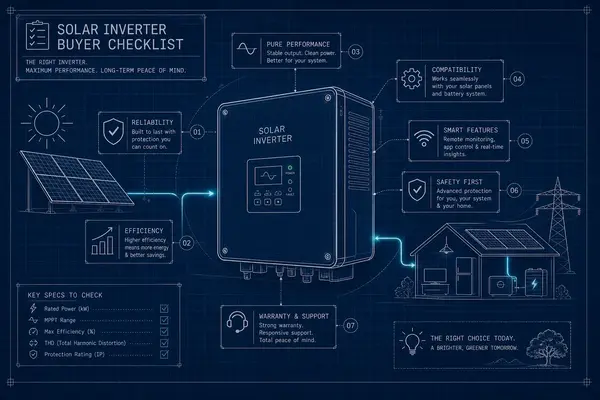
You've approved a solar quote. The installer hands you a spec sheet with model numbers, wattage ratings, and efficiency percentages, and you have no idea whether what you're looking at is a solid system or a liability waiting to happen. That's not a failure on your part. It's a gap in how the solar industry communicates with homeowners, and it's exactly the gap this guide fills. If you've ever asked yourself what should I look for when buying a solar inverter, you're in the right place.
The inverter is the brain of your solar system. It determines how much of your panels' output actually reaches your home, how your system behaves during a grid outage, and whether you're battery-ready five years from now when electricity rates have climbed and you finally want storage. Getting the inverter right is the highest-leverage decision in any residential solar purchase.
At Smart Home Authority, we've reviewed and broken down dozens of inverter models across all three main types. This checklist covers inverter type selection, sizing math, efficiency ratings that actually matter, warranty red flags, monitoring features, and the questions you need to bring to every installer conversation before you sign anything.
What should I look for when buying a solar inverter: the three types explained
This is the first and most consequential decision you'll make. The inverter type you choose affects your upfront cost, shading tolerance, long-term reliability, and whether you can add battery storage without a costly retrofit later. Installers don't always present all three options upfront, so knowing the difference gives you real leverage in that conversation. For a concise comparison of string, micro, and hybrid options, see types of solar inverters: string, micro, and hybrid compared.
String inverters: the right choice for simple, unshaded roofs
A string inverter is a single centralized unit that converts DC power from a series of panels into AC power for your home. It's wall-mounted, accessible without roof access, and the lowest-cost option on the market. The weakness is what's called the string effect. One underperforming panel, due to shading, debris, or damage, pulls down the output of every other panel on that string. String inverters also typically last 10 to 15 years, meaning you'll replace the inverter at least once before your panels reach end-of-life.
Microinverters: when your roof has shading or complexity
Microinverters attach individually to each panel, converting DC to AC at the source. Every panel operates independently, so a shadow on one section of your roof doesn't drag down the rest of the system. On complex or partially shaded roofs, real-world energy recovery can run 5 to 25% higher than a comparable string setup. Microinverters also match the 25-year lifespan of your panels, eliminating the mid-system replacement cost you'd face with string inverters. The trade-off is a significantly higher upfront cost, and any warranty repair requires roof access since the units sit under each panel.
Hybrid inverters: the battery-ready option worth serious consideration
A hybrid inverter manages solar conversion and battery storage in a single unit, coordinating power flow between your panels, batteries, the grid, and your home. If you plan to add backup storage now or within the next few years, a hybrid eliminates the need to retrofit additional equipment later. It also allows direct DC-to-battery storage, which is more efficient than AC-coupled alternatives because it skips an extra conversion step. The higher upfront cost is the main barrier, and you'll want to confirm battery compatibility with the specific brand before committing.
What should I look for when buying a solar inverter: sizing and efficiency
An undersized inverter clips your system's peak output, wasting energy during the sunniest hours of the day. An oversized one runs inefficiently at partial load for the majority of each day. Getting the sizing right requires two separate calculations: the DC-to-AC ratio for your array and the continuous output rating relative to your household's peak load. For more on how installers approach these calculations, check this guide to inverter sizing.
The DC-to-AC ratio rule of thumb
The DC-to-AC ratio, also called the Inverter Loading Ratio, compares your total panel wattage to the inverter's AC output rating. The residential sweet spot in the US is 1.25:1. A 20-panel array at 400W per panel gives you 8,000W DC; pair it with a 6,400W AC inverter and you hit that ratio cleanly. Slight array oversizing is intentional because most panels rarely hit nameplate capacity, and a smaller inverter running at 85 to 95% capacity for longer daily stretches captures more cumulative energy than a perfectly matched unit sitting at partial load most of the day.
Matching continuous output to your household's peak load
The inverter's continuous output rating must handle the maximum simultaneous wattage your home draws, not just your average daily consumption. A practical rule: the continuous rating should be at least 125% of your total peak load. Factor in surge ratings for appliances with motors, specifically HVAC compressors and well pumps, which draw significantly more power at startup than their rated wattage. Add approximately 20% on top of your raw calculations to account for shading losses, temperature derating, and wiring inefficiencies.
CEC weighted efficiency vs. peak efficiency: which number to trust
Inverter spec sheets lead with peak efficiency numbers because they look impressive. A 99% peak efficiency rating sounds exceptional until you understand that inverters almost never operate at the load level where that peak occurs.
The CEC (California Energy Commission) efficiency rating is a weighted average calculated across six load levels, from 10% to 100% of rated output, simulating how an inverter actually performs throughout a typical day, including early morning ramp-ups, cloudy periods, and partial loads. These ratings typically land at 96 to 97% for strong string inverters and 97 to 98% for top-tier microinverters. Always compare CEC efficiency figures across competing models, never peak ratings. A 1 to 2% real-world efficiency difference compounds to thousands of dollars over a 25-year system lifetime. For deeper context on how efficiency affects system yield, see this article on the impact of inverter efficiency on overall solar system performance.
How MPPT inputs and voltage range drive your daily yield
MPPT (Maximum Power Point Tracking) continuously adjusts the inverter's operating point to extract maximum available power from the panels under varying light and temperature conditions. The number of independent MPPT inputs matters when your roof has panels facing different directions or at different tilts; multiple MPPTs allow each section to operate at its own optimal point rather than being pulled down by the lowest-performing string. A wider MPPT voltage range extends the daily generation window by allowing the inverter to capture usable energy during low-light morning and evening conditions when lesser systems have already shut down.
Warranty coverage and NEC compliance: the specs installers skip
Warranty length is often the most telling indicator of a manufacturer's confidence in their own product. NEC rapid shutdown compliance is a legal requirement in most US jurisdictions. Both directly affect your safety and your long-term financial exposure, yet neither gets enough attention during a typical installer sales conversation.
What inverter warranties actually cover (and what they don't)
String inverters from major US brands typically carry 10 to 12 year standard warranties, with paid extensions to 20 to 25 years available at the time of purchase. Some microinverter brands offer 25-year baseline warranties that match your panel life, eliminating the mid-system replacement scenario entirely. Read the fine print carefully: most warranties cover product defects but exclude labor and shipping costs for replacement units. Some brands offer labor reimbursement during the first five years; others don't. Confirm transferability if there's any chance you'll sell the home before the system is paid off, because this detail affects your resale value directly.
Rapid shutdown requirements and grid-tie compliance
The NEC requires rapid shutdown capability for rooftop solar systems, meaning the system must reduce panel-level voltage to 30 volts or less within 30 seconds when a breaker is opened or the inverter detects a grid outage. Most modern inverters built for the US market include rapid shutdown compliance, but verify it explicitly, especially if you're evaluating older inventory or less common brands. For recent regulatory context, review the 2023 NEC updates to rapid shutdown requirements. Grid-tie inverters must also be UL 1741-listed and comply with IEEE 1547 standards for grid interconnection. These are non-negotiable for utility approval and net metering eligibility in every state.
Monitoring software and battery-readiness: the features worth paying for
Two categories of inverter features are consistently undervalued during the buying process: real-time monitoring and battery integration architecture. Both have a direct impact on how much value you extract from the system over its lifetime, and both deserve evaluation before you commit to a brand.
What good inverter monitoring software should show you
Strong monitoring platforms give you panel-level or string-level performance data in real time, not just system-wide totals. A single underperforming panel can quietly cost you hundreds of kilowatt-hours per year without triggering any obvious alert if your monitoring only shows aggregate output. Look for platforms that include production vs. consumption dashboards, historical generation data, fault alerts pushed to your phone, and the ability to share data access with your installer for remote diagnostics. App quality and data retention vary significantly between manufacturers, testing a demo before locking into a brand is time well spent.
AC-coupled vs. DC-coupled: what it means for battery backup and EV charging
If you plan to add battery storage or integrate EV charging, the coupling architecture of your inverter determines both the efficiency and the complexity of that integration. DC-coupled hybrid inverters store solar energy directly in the battery without an extra conversion step, achieving higher round-trip efficiency. AC-coupled systems are more flexible for retrofits and work with existing microinverter setups, but they lose roughly 10% efficiency in the battery-to-home conversion cycle. For bidirectional EV charging (V2H or V2G), you'll also need an inverter that supports ISO 15118-20 communication protocols and an automatic transfer switch for seamless backup operation.
Questions to bring to every installer quote
Armed with the specs above, you're in a position to pressure-test any installer proposal before signing. The goal is targeted questions that expose whether the proposed system fits your home or simply the path of least resistance for the installer.
The short checklist to bring to your installer meeting
Ask these directly and pay close attention to how confidently the installer responds. Vague answers to straightforward technical questions are a red flag worth acting on.
-
What is the DC-to-AC ratio of the proposed system, and why did you choose this inverter size?
-
What is the CEC efficiency rating of this inverter, not the peak rating?
-
How many independent MPPT inputs does it have, and does that match my roof layout?
-
What does the standard warranty cover, and what are the extension options and costs?
-
Is rapid shutdown NEC-compliant, and will this inverter qualify for net metering in my utility's territory?
-
Is this inverter battery-ready, and if I add storage in three years, what batteries is it compatible with?
Where to go for deeper model-level comparisons
Once you've narrowed your inverter type and confirmed the core specs above, the next step is comparing specific models side by side. Smart Home Authority publishes dedicated inverter comparison guides that break down real-world performance data, monitoring platform quality, and compatibility matrices for the top residential brands on the US market. If you're deciding between a string inverter with power optimizers and a full microinverter system, or evaluating which hybrid inverters pair cleanly with LFP battery banks, those guides are the logical next read before you finalize any quote.
For additional reading across the Smart Home Authority site, see Smart Home Authority. If you're also shopping for complementary home-tech, our Top 5 aesthetic home tech items guide highlights products that elevate everyday living, and for practical takeaways you can use outside the home, check the portable electric air inflator review.
Use this checklist before you sign anything
Knowing what should I look for when buying a solar inverter comes down to a handful of criteria that separate a high-performing system from an expensive disappointment. Match the inverter type to your roof profile and future storage plans. Verify the DC-to-AC ratio. Compare CEC efficiency figures instead of peak ratings. Confirm warranty coverage in writing, including labor terms and transferability. Check NEC compliance before any paperwork is signed.
The specs in this checklist drive long-term system performance and financial return, not the marketing numbers on a spec sheet. A higher upfront cost on the right inverter will outperform a budget choice within the first few years, and the compounding efficiency and reliability advantages only grow from there. Use these criteria as your filter, and you'll walk into every installer conversation with the clarity to tell a strong proposal from a mediocre one. For a deeper look at specific models, visit Smart Home Authority's inverter comparison guides and find the right fit for your home.
Frequently asked questions
What should I look for when buying a solar inverter for a shaded roof?
Prioritize microinverters or a string inverter paired with power optimizers. Both approaches allow each panel to operate independently, so shading on one section doesn't reduce output from the rest of the array. Compare CEC efficiency ratings across competing models rather than peak ratings, and confirm the number of independent MPPT inputs matches the number of distinct roof orientations in your layout.
What should I look for when buying a solar inverter if I want battery backup?
Choose a hybrid inverter with DC-coupled architecture. This setup stores solar energy directly in the battery without an extra conversion step, delivering higher round-trip efficiency than an AC-coupled retrofit. Confirm battery compatibility with the specific hybrid model before purchasing, and verify that the inverter includes an automatic transfer switch for seamless backup operation during a grid outage.
How do I know if a solar inverter warranty is solid?
Check what the warranty actually covers, most policies cover manufacturing defects but exclude labor and shipping costs. Look for brands offering at least 10 to 12 years standard on string inverters, with paid extension options to 20 to 25 years. Confirm whether the warranty is transferable if you sell your home, and ask about labor reimbursement terms during the first five years of ownership.